AI Reads Scalp EEG Across Seven Disorders — With a Confidence Estimate
NeuroMCP-Agent analyzes scalp EEG across seven neuropsychiatric conditions with reported accuracies up to 100%, but stricter testing drops Parkinson's to 92.4% — evaluation design is the story.
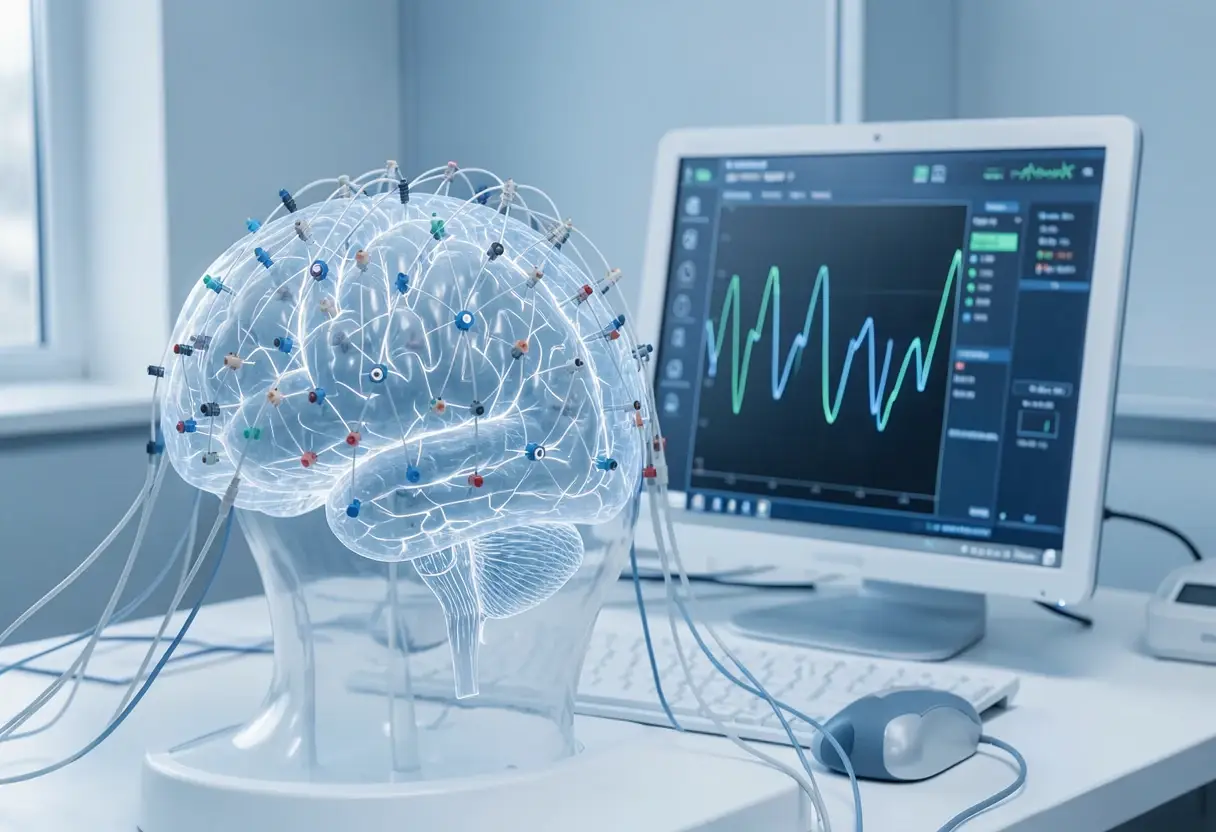
An AI system analyzing scalp EEG reports 100% accuracy for Parkinson's disease screening — yet the same study's stricter leave-one-out evaluation cut that figure to 92.4%, and that gap is the story practitioners should read carefully. Rakesh Kumar Reddy Ambati, an Application System Analyst at Dartmouth Health, developed the system, called NeuroMCP-Agent, to screen seven conditions from electroencephalogram recordings: Parkinson's disease, epilepsy, schizophrenia, chronic stress, Alzheimer's disease, autism spectrum disorder and major depression. This is investigational research, not an FDA-cleared device.
What does the pipeline actually do?
The system processes scalp EEG — non-invasive recordings that are vulnerable to movement, eye blinks, muscle activity and recording conditions — through filters and noise-removal stages. It then segments recordings into four-second windows with 75% overlap and extracts 47 measurements covering brain-wave frequencies, signal complexity and irregularity.
Training data were expanded fifteen-fold through generated variations to compensate for limited recordings. Augmented data do not equal new patients. The paper itself flags that careful separation of training and testing data is essential to prevent data leakage, a point any reader of high-accuracy EEG papers will recognize.
The classifier is an "Ultra Stacking Ensemble" combining 15 algorithms, selecting 300 informative outputs and integrating them through a final model. Monte Carlo dropout generates repeated predictions with small random perturbations to estimate how confident each output should be.
Which features drive the predictions?
The study identifies gamma-power ratio, theta–beta balance, signal unpredictability and complexity as the most important predictive features. Ablation experiments quantify each component's contribution:
- Accuracy dropped 3.21 percentage points without data augmentation.
- Replacing the ensemble with a single algorithm cost 5.77 points.
- Reducing the feature set from 47 measurements to 20 cost 4.96 points.
Those ablations support the design within the reported experiments. Independent testing remains necessary to establish generalizability.
How accurate — and under which evaluation?
The headline evaluation reported the following accuracies: 100% for Parkinson's disease, 99.02% for epilepsy, 97.67% for autism spectrum disorder, 97.17% for schizophrenia, 94.20% for Alzheimer's disease, 94.17% for chronic stress and 91.07% for major depression. Corresponding AUC values ranged from 0.956 to 1.000.
The stricter leave-one-out evaluation told a different story: 92.4% for Parkinson's and 91.2% for schizophrenia. The difference is a lesson in evaluation design. The 100% figure must be reported alongside the lower one, never as a universal guarantee.
What about the governance claims?
The paper describes a responsible AI framework with 46 modules and more than 1,300 analysis types, covering fairness, privacy, safety, transparency and robustness, with SHAP and LIME used to explain predictions. The reported governance score is 0.91 out of 1, mapped to expectations associated with the EU AI Act, US FDA guidance for medical software and HIPAA privacy rules.
That mapping is a research-defined self-assessment. It is not regulatory approval, formal certification or proof of legal compliance, and privacy claims should not be described as guaranteed without documented evidence of the specific tests performed.
What are the limits for clinical readers?
The study draws on single-centre data, which limits conclusions across hospitals and patient populations. EEG varies with recording conditions, medications and comorbidities. The system performs classification only; it does not assess disease severity or distinguish closely related subtypes. The paper calls for multi-centre studies, detailed participant numbers, reference standards and uncertainty around performance estimates.
Proposed future directions include federated learning, portable EEG devices, integration with other clinical information and predictive applications such as identifying signs preceding epileptic seizures — all proposed developments, not established capabilities.
The bottom line
NeuroMCP-Agent pairs EEG-based classification with uncertainty estimation, explainability and governance assessment, and its reported results are promising. But the spread between 100% and 92.4% Parkinson's accuracy under different evaluation schemes is exactly why rigorous, transparent testing matters before any reading room adopts such a tool. If independent multi-centre studies reproduce these findings, the system may eventually support EEG-based screening and clinical decision support. For now it remains research, not a validated diagnostic replacement.
Based on
Source: Google News: EEG.
Marcus Bennett
Show full bio
Staff writer covering technology and product news in Clinical neurophysiology and EEG interpretation at EEG Signal.