Karate Training and the Developing Brain: P300 Findings in Children
Scalp-EEG P300 during a Go/No-Go task compared karate-practicing children with non-practitioners across biological maturation stages to probe attention and working memory.
Updated
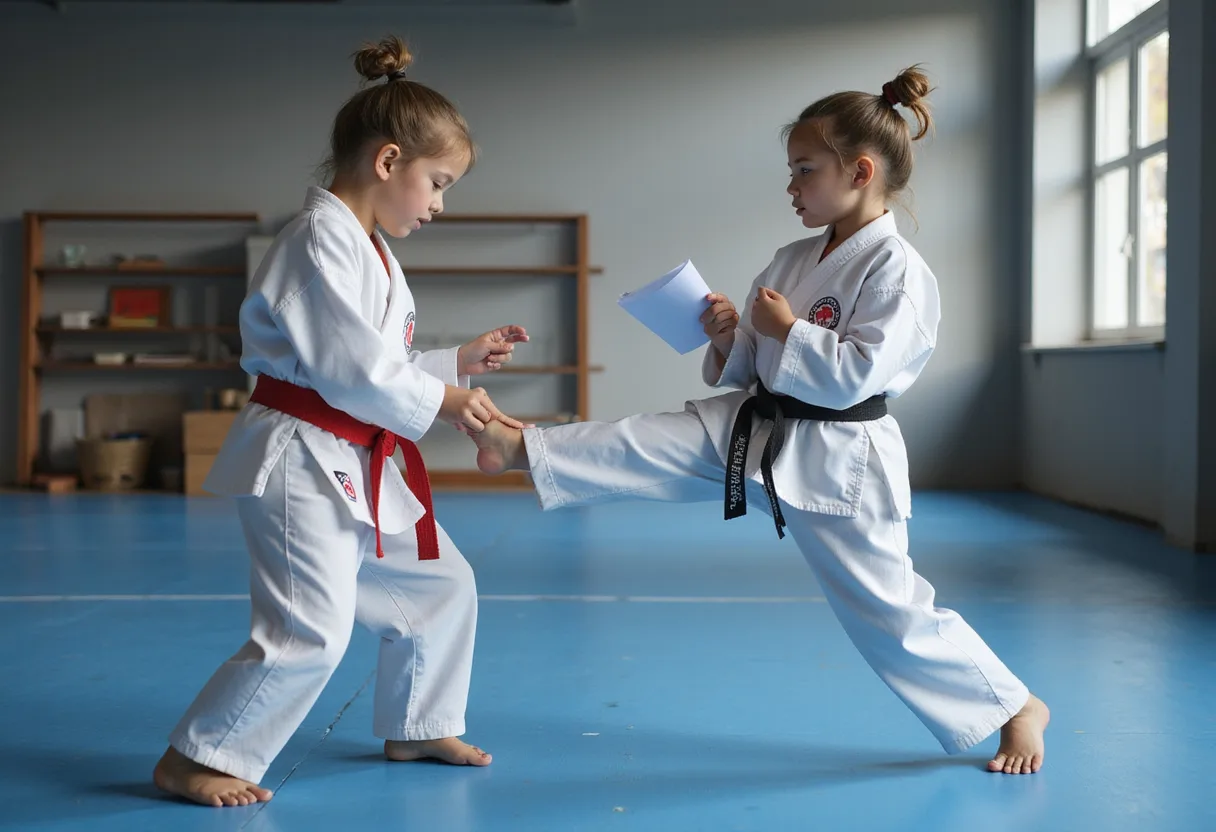
A new study in Clinical EEG and Neuroscience has examined whether karate practice shapes the neural correlates of attention and working memory in children, using the P300 event-related potential recorded during a Go/No-Go paradigm as its primary outcome measure.
The research team compared children who practice karate with non-practitioners at different stages of biological maturation. Rather than grouping children by chronological age alone — a common confound in pediatric neurophysiology, given the wide individual variance in pubertal timing — the investigators anchored their comparison to biological maturation stage. That design choice matters for anyone reading pediatric evoked-potential data: P300 amplitude and latency change substantially across development, and maturation-matched cohorts reduce the risk of attributing developmental differences to an intervention.
The P300 component, recorded here from scalp EEG during a Go/No-Go task, is a well-established index of attention allocation and working-memory updating. The Go/No-Go paradigm itself adds an inhibitory-control dimension, since participants must withhold responses to nontarget stimuli — a demand that engages frontally mediated response inhibition alongside the classic P3b processes captured at posterior sites. In the context of martial arts training, which couples sustained attention with motor sequencing and impulse control, the paradigm is a reasonable probe of the cognitive functions the training is thought to exercise.
Why the question is worth asking is straightforward. Youth martial arts programs are widely promoted as attention-building activities, yet claims about their neural effects frequently outpace the electrophysiological evidence. Event-related potentials offer a noninvasive, scalp-recorded, temporally precise way to test those claims in children — no intracranial recording, no investigational hardware, just standard EEG equipment already present in most clinical neurophysiology labs.
For EEG researchers and clinicians who follow the developmental ERP literature, the study contributes to a growing body of work on how structured physical and cognitive training relates to electrophysiological markers in school-age children. The maturation-stratified design is the study's distinctive feature. Prior investigations of exercise and cognition in children have often pooled participants across wide age ranges, which can obscure both training effects and maturational trajectories. By separating cohorts by biological maturation stage, the authors can ask whether any association between karate practice and P300 measures holds uniformly, or whether it emerges — or attenuates — at particular developmental windows.
The practical relevance extends beyond the lab. If sustained martial arts practice tracks with differences in P300 amplitude or latency at specific maturation stages, that would add a measurable neurophysiological dimension to discussions about activity-based interventions for attention in children. It would not, by itself, establish causation — cross-sectional comparisons of practitioners and non-practitioners cannot exclude self-selection effects, and the usual confounds of socioeconomic factors, baseline attention, and general physical activity remain in play. But it would sharpen the hypotheses that longitudinal training studies could then test with dense-array EEG.
The study appears in Clinical EEG and Neuroscience as an ahead-of-print article. Readers working in pediatric neurophysiology, sports-medicine research, and developmental cognitive neuroscience will find the maturation-stage framing a useful template for future ERP work in children — one that other investigators studying training-related plasticity would do well to adopt.
Whether karate and comparable disciplines produce reliable, maturation-stage-specific shifts in the P300 will ultimately require prospective designs with repeated recordings. This investigation lays the electrophysiological groundwork for exactly that next step.
Based on
Source: Clinical EEG and Neuroscience (SAGE).
Tom Whitfield
Show full bio
Senior reporter covering people, launches and day-to-day practice in Clinical neurophysiology and EEG interpretation at EEG Signal.