Magnetic NeuroRing pairs BCI with TMS for stroke rehab
Nature publishes the Magnetic NeuroRing, a portable adaptive BCI that triggers real-time TMS for post-stroke motor rehabilitation — an investigational closed-loop platform.
Updated
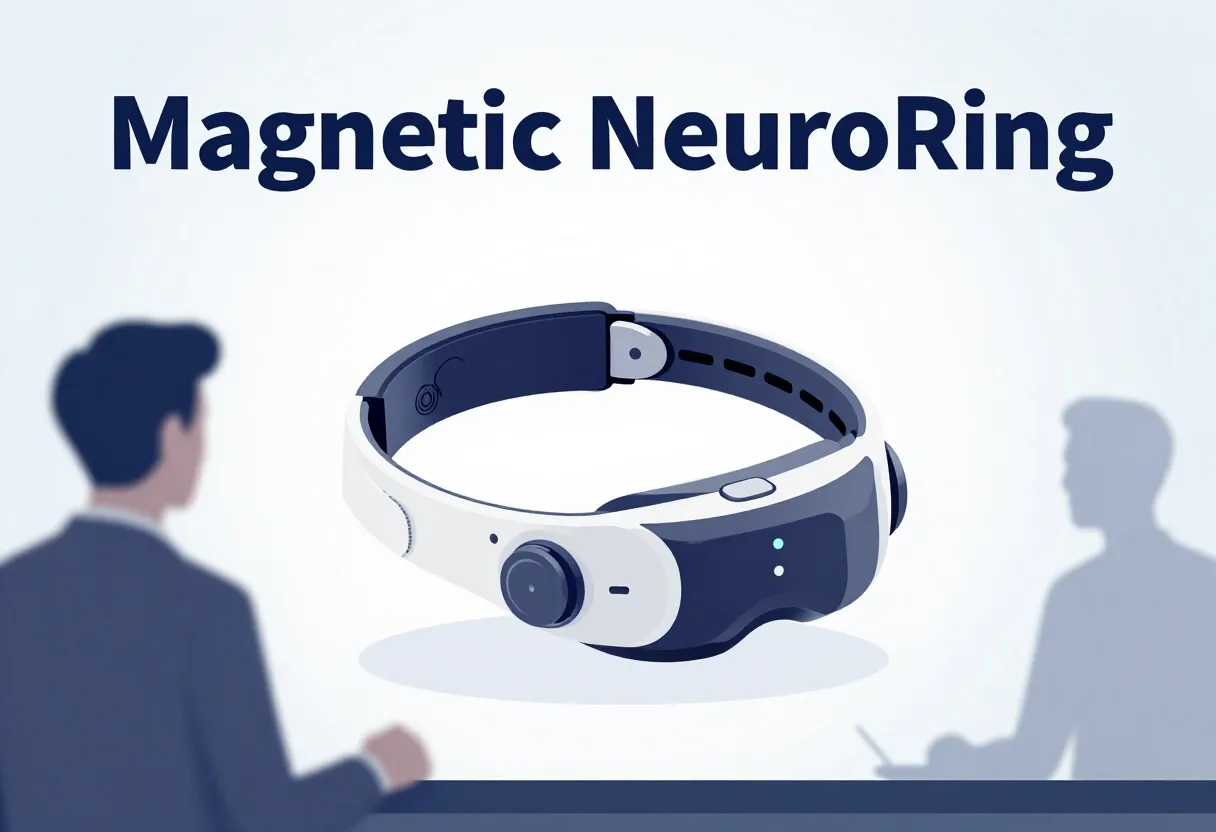
Nature has published a study describing the Magnetic NeuroRing, a portable adaptive brain-computer interface that delivers real-time transcranial magnetic stimulation (TMS) to support motor rehabilitation after stroke.
The system targets one of the persistent practical gaps in post-stroke motor recovery: coupling a patient's own brain-state signals to stimulation at the moment those signals occur, rather than running stimulation on a fixed, open-loop schedule. The device integrates the recording side of a brain-computer interface with the stimulation side of TMS in a single wearable format, and it adapts its operation in real time as the patient's neural activity changes across a session.
What the publication covers
According to the paper, the Magnetic NeuroRing combines three functions that normally require separate hardware and a tethered laboratory setup:
- acquisition of ongoing brain activity through the BCI's sensor front end;
- online decoding of task-relevant neural states;
- closed-loop triggering of transcranial magnetic stimulation timed to those states.
The stated application is post-stroke motor rehabilitation, a field where repetitive TMS and transcranial direct current stimulation have been studied extensively, but where portable, patient-worn closed-loop platforms have remained largely out of reach. Conventional TMS systems are bulky, require an operator, and typically run open-loop protocols that ignore moment-to-moment fluctuations in cortical excitability.
The "NeuroRing" form factor suggests a head-worn ring configuration that carries both the sensing electronics and the magnetic stimulator, allowing the patient to move — a meaningful departure from coil-and-chair setups confined to the clinic.
Closed-loop logic
The adaptive component is the study's central technical claim. Rather than stimulating at predetermined intervals, the device monitors the user's neural signals through its BCI channel and adjusts stimulation parameters based on the decoded state. In motor rehabilitation research, this approach follows the rationale that stimulation is most effective when paired with voluntary motor intent or with specific oscillatory brain states — the same timing principle that underlies paired-associative stimulation and BCI-triggered robotic therapy studies.
The publication frames the system as a research and rehabilitation platform rather than a commercial product. No regulatory clearance claims appear in the available material, and readers should treat the device as investigational until clinical trial data and regulatory review are reported.
Practice implications for clinical neurophysiology
For monitoring-unit and reading-room audiences, the work matters for several reasons:
-
Portability changes the delivery model. A wearable closed-loop stimulator moves brain-state-triggered therapy out of the TMS laboratory and into rehabilitation gyms, and potentially the home — if subsequent validation supports it.
-
The BCI front end defines the signal quality question. Closed-loop performance depends on how well the device records and decodes neural activity despite motion artifact and the electromagnetic interference its own stimulator generates. The Nature paper addresses the engineering design; independent replication of decoding accuracy in freely moving patients remains the key test.
-
Stroke motor rehabilitation is the beachhead, not the ceiling. If a portable adaptive platform proves safe and effective in this population, the same closed-loop architecture could extend to other neuromodulation targets — though the current publication concerns post-stroke motor recovery specifically.
What to watch next
The study establishes feasibility and design principles for the Magnetic NeuroRing. The field will now look for controlled clinical data in stroke patients: motor outcome measures across a rehabilitation course, comparison against standard-of-care therapy and open-loop stimulation, and safety monitoring over repeated sessions. Those results will determine whether closed-loop, patient-worn magnetic stimulation becomes a routine neurorehabilitation tool or remains a laboratory demonstration.
Based on
Olivia Hart
Show full bio
Correspondent covering people, launches and day-to-day practice in Clinical neurophysiology and EEG interpretation at EEG Signal.