Nature Publishes "Symbiotic" Brain-Machine Drawing via Visual BCI
A Nature study demonstrates "symbiotic brain-machine drawing" — human and machine jointly creating images through a visual brain-computer interface, a non-clinical research finding.
Updated
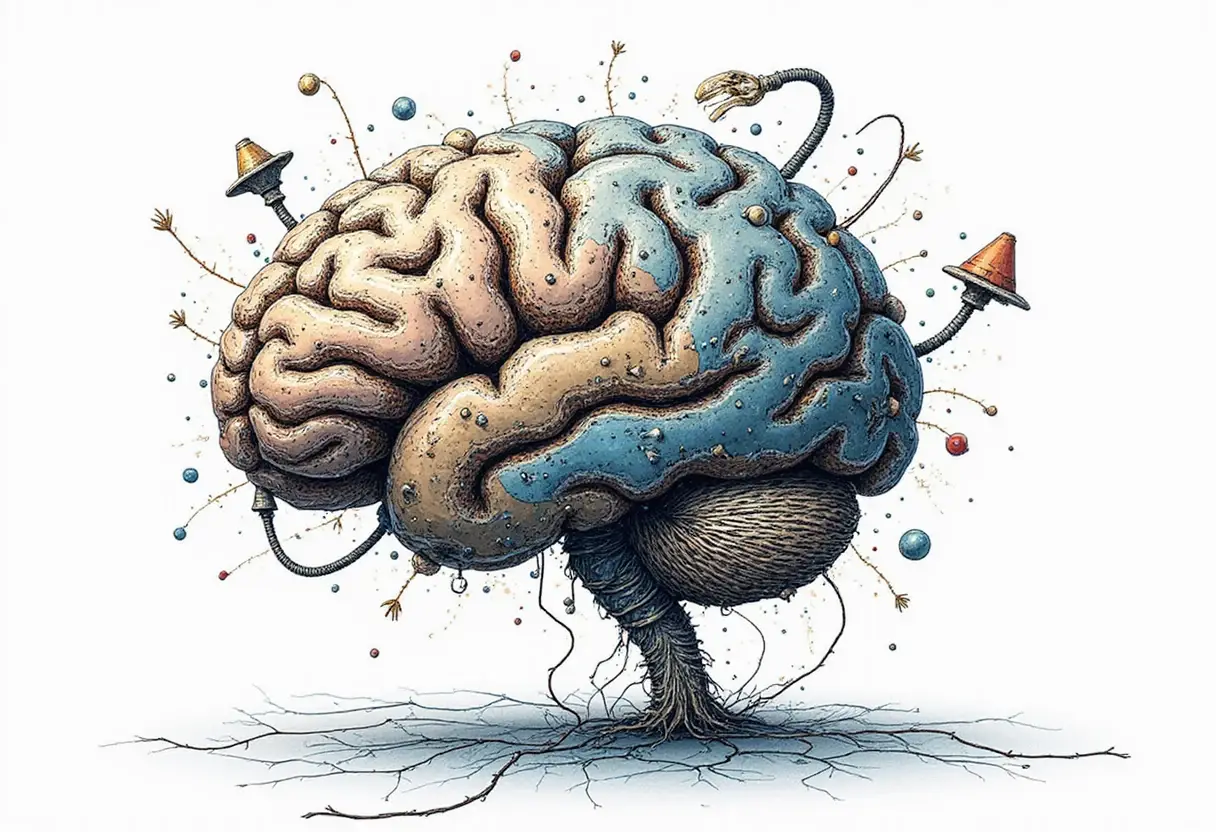
A study titled "Symbiotic brain-machine drawing via visual brain-computer interfaces" has appeared in Nature, describing a system in which a human participant and a machine jointly produce drawings through a visual brain-computer interface (BCI).
The title itself frames the central claim: this is not a device that reads artistic intent from the brain wholesale. It is a symbiotic setup — the human and the machine each contribute to the drawing process, with the visual BCI serving as the channel between them.
What the title establishes
The source material available for this report consists of the paper's title and its venue, Nature. From that, several points are firm.
First, the recording modality is a visual brain-computer interface. In BCI parlance, "visual" interfaces typically rely on electrophysiological signals time-locked to visual stimuli — the P300 and steady-state visually evoked potential (SSVEP) paradigms being the standard scalp EEG-based approaches. The paper's title does not specify the exact signal, montage, or number of electrodes, and we will not speculate beyond what is stated.
Second, the application is drawing — the generation of graphical output — rather than the more familiar BCI targets of cursor control, spelling, or prosthetic actuation. That places the work in the growing cluster of neurofeedback and BCI studies exploring creative expression and human–machine co-creation rather than pure assistive communication.
Third, the word "symbiotic" is doing specific work. It signals that neither the human nor the algorithm produces the artwork alone. The machine contributes generative or interpretive capability; the human contributes intent, selection, or evaluative judgments communicated through the interface.
Why this matters for the reading room and the lab
For clinical neurophysiologists and BCI researchers, creative-output studies serve a practical function: they stress-test interface paradigms under conditions far noisier than a calibrated spelling task. A user asked to make aesthetic judgments or guide a drawing makes decisions that are slower, more ambiguous, and less cleanly time-locked than a target-selection trial. Any interface that holds a signal under those constraints demonstrates robustness that matters for real-world deployment.
Visual BCIs built on scalp EEG have the advantage of being non-invasive and comparatively cheap — standard electrode caps, standard amplifiers, paradigms a clinical EEG laboratory could implement without intracranial hardware. That distinguishes them clearly from ECoG- or depth-electrode-based BCIs, which require implanted grids and are confined to investigational or presurgical-monitoring contexts. Nothing in the available source indicates whether the Nature study used scalp or intracranial recording, and readers should treat that detail as unresolved until the full text is consulted.
The regulatory status is likewise straightforward to state: this is peer-reviewed research published in Nature, not an FDA-cleared device. No clinical claims follow from it, and the drawing output is not a diagnostic or therapeutic product.
What the study demonstrated — and what it did not
Staying within what the title supports: the study demonstrated brain-machine drawing — graphical output produced through a visual BCI in a symbiotic arrangement between user and machine.
It did not, on the evidence available here, claim that the system decoded mental images, reconstructed perception, or "read minds." Such claims circulate widely around creative BCI work and should be resisted. A visual BCI selects among options or modulates an ongoing process using electrophysiological signatures of visual attention and recognition; the creative result emerges from the loop between that signal and the machine's generative machinery.
For readers tracking the neurofeedback and BCI literature, the relevant benchmark questions when the full paper is examined are concrete. How many participants completed the task, and were they trained or naive? What was the classification accuracy or information-transfer rate of the visual interface during drawing, compared with standard calibration tasks? Was the recording scalp EEG, and with what montage? And how did the authors evaluate the drawings — by participant report, by external raters, or by some quantitative measure of the human–machine contribution split?
Those are the details that determine whether "symbiotic drawing" is a demonstration with a handful of practiced users or a paradigm that generalizes.
The broader arc
Creative BCIs sit at the intersection of two literatures the EEG community knows well: evoked-potential classification, which supplies the decoding machinery, and neurofeedback, which supplies the training framework. A Nature publication in this space signals that the creative-application side of the field has reached the bar of a top-tier general-science venue — historically a marker that a BCI subfield is moving from proof-of-concept toward systematic methodology.
The venue also raises expectations for rigor. Nature papers in the BCI space typically come with substantial participant cohorts, pre-registered analyses, or demonstrations across multiple users, so the full text is likely to answer the cohort and montage questions raised above.
For now, the headline finding stands on its own: a visual brain-computer interface has been used to achieve symbiotic brain-machine drawing, published in Nature on the strength of that demonstration. Whether the approach scales beyond the laboratory — and whether the visual BCI component maintains its signal quality outside controlled stimulus conditions — is the question the authors' next experiments will need to answer.
Based on
Elena Vasquez
Show full bio
News editor covering people, launches and day-to-day practice in Clinical neurophysiology and EEG interpretation at EEG Signal.