Neuroscience Gave AI Its Start. Sussillo Says the Flow Has Reversed
McCulloch and Pitts built the artificial neuron from biology in the 1940s. Sussillo says the flow has reversed: AI may get a deep theory before the brain does.
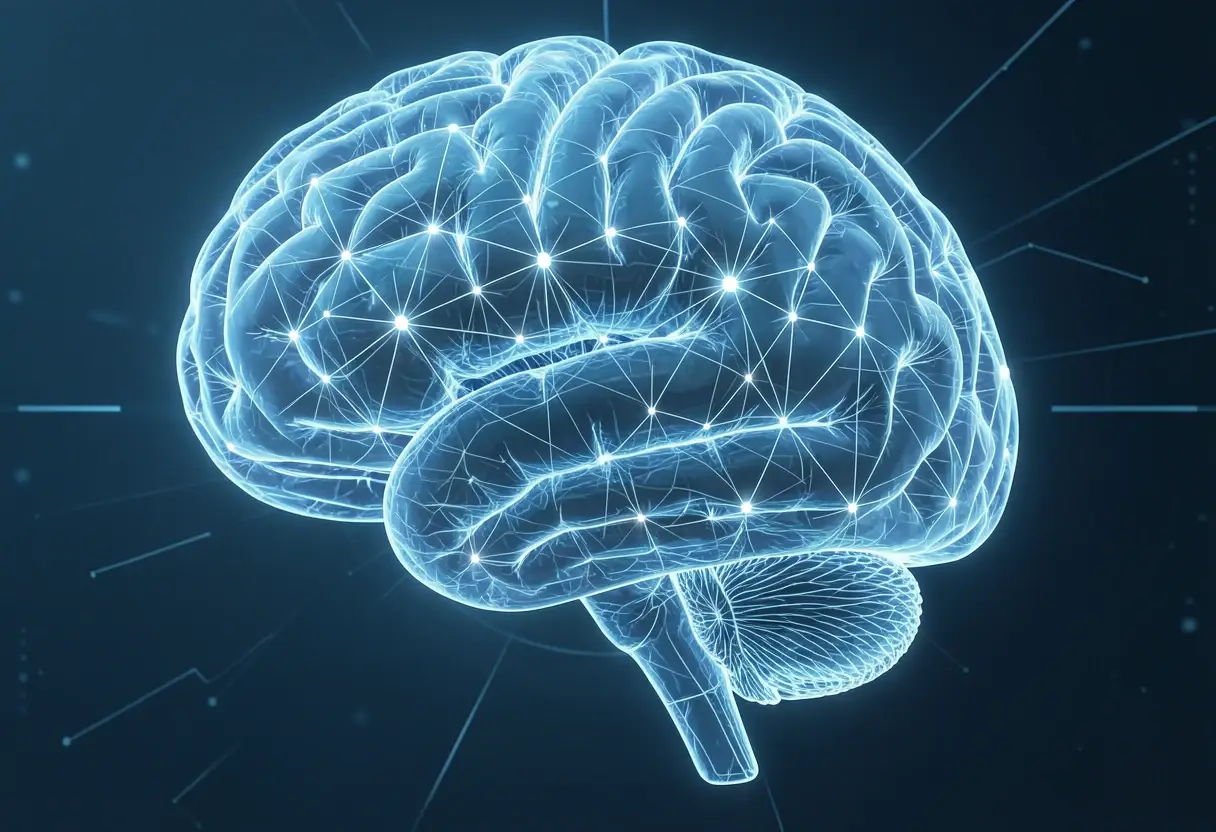
Neuroscience inspired artificial intelligence for roughly seventy years, and now the debt is running the other way, according to computational neuroscientist David Sussillo, who spent almost two decades at Google Brain and Meta Reality Labs and holds an academic appointment at Stanford University.
Sussillo laid out his assessment in an interview with The Transmitter, tracing the relationship from its origins to what he calls a genuine reversal of intellectual traffic.
Where did AI actually come from?
The field began with brain research, Sussillo said. Warren McCulloch and Walter Pitts, working in the mid-1940s, derived the idea of the artificial neuron by abstracting the electrical properties of biological neurons. "Neuroscience really did originally provide the intuition and some of the guiding principles for AI. But that's no longer true today," he said.
The decisive inheritance was the connectionist idea — the principle that intelligence arises from connections between neurons rather than from the intrinsic properties of the neurons themselves. AI researchers took that concept and ran with it through the 1980s, 1990s and 2000s. Artificial neural networks did not begin working reliably until about 2012, Sussillo noted, which is when questions about how these systems function became scientifically urgent.
Can neuroscientists explain AI systems?
Google Brain hired Sussillo in 2014 precisely on this argument: that neuroscientists, long practiced at probing opaque systems, would be suited to interpreting functioning neural networks. His verdict on the effort since is blunt. "I don't think the neuroscience program has been overly successful in understanding AI," he said, citing three obstacles:
- Neuroscience itself has not solved the brain, so its theories remain nascent.
- AI technology changes quickly, driven by engineering as much as science, and outpaces academic analysis.
- Large AI systems likely require multiple disciplines — statistical physics, mathematics, cognitive science — to be understood at all.
He sees one structural advantage that makes him optimistic about theory: researchers have the entire AI system available for interrogation, unlike in neuroscience. "It's not crazy to think that we'll have deep theories of AI before we do of the brain, simply from a consideration of experimental limitations," Sussillo said. "We don't have access to the whole machine in neuroscience."
Large language models have shifted the terrain again, he argued. They move beyond single-pass deep learning into chain-of-thought reasoning — models that, in his phrasing, think in language. That opens cognitive-science-style questions about a trained network's inference mode, questions that did not exist when he entered the field.
What does this change for trainees?
Graduate students increasingly take internships at AI companies and move into industry after their Ph.D.s. Sussillo, drawing on his hiring experience, called the internships a win-win: students sample industrial research culture, and companies de-risk nontraditional candidates. He also flagged a persistent curricular gap — university experimental rigs still run largely on MATLAB, while industry works in Python, which he said holds some graduates back and should have been solved a decade ago.
On private funding, including crypto wealth flowing into NeuroAI, Sussillo was pragmatic. Corporate money tends to arrive as one-off, short programs: a corporate time horizon of three to five years against academia's ten means no lab can be built around it. He pointed to Astera, led by Doris Tsao, as an apparent community win. Crypto funders, he said, often arrive with science-fiction goals such as mind uploading, and the real task is translating those ambitions into scientifically sound research programs — much of which he guesses is doable.
Will the brain teach AI anything new?
Near-term, Sussillo is skeptical. Skulls are, in his words, essentially biological safes, and experimental neuroscience can record from only a minuscule fraction of neurons. Within five years he expects no brain-derived insight to change AI's course; over ten to twenty years he is open to it. He cited Naveen Rao of Brown University, who founded a company applying dynamical-systems ideas from neuroscience to energy savings in deep learning — inspiration, not replication.
His one proposed moonshot is a large foundation model built on high-quality neural data — a virtual mouse brain — which would put neuroscience on parity with AI systems and allow rapid, unrestricted interrogation. Whole-brain dynamics, he noted, remain almost entirely unknown.
The irony he draws is direct: in the short term, AI will almost surely help neuroscience, while in the long term, neuroscience may still unveil secrets of its own — if it builds the tools to interrogate itself at scale.
Based on
Original: davidsussillo.com.
Olivia Hart
Show full bio
Correspondent covering people, launches and day-to-day practice in Clinical neurophysiology and EEG interpretation at EEG Signal.