Ultrasound BCI paper covers transcranial closed-loop neuromodulation
Science Partner Journals releases "Ultrasound Brain–Computer Interfaces for Transcranial Closed-Loop Neuromodulation." The release names the modality but lists no device specs, cohort, or FDA status.
Updated
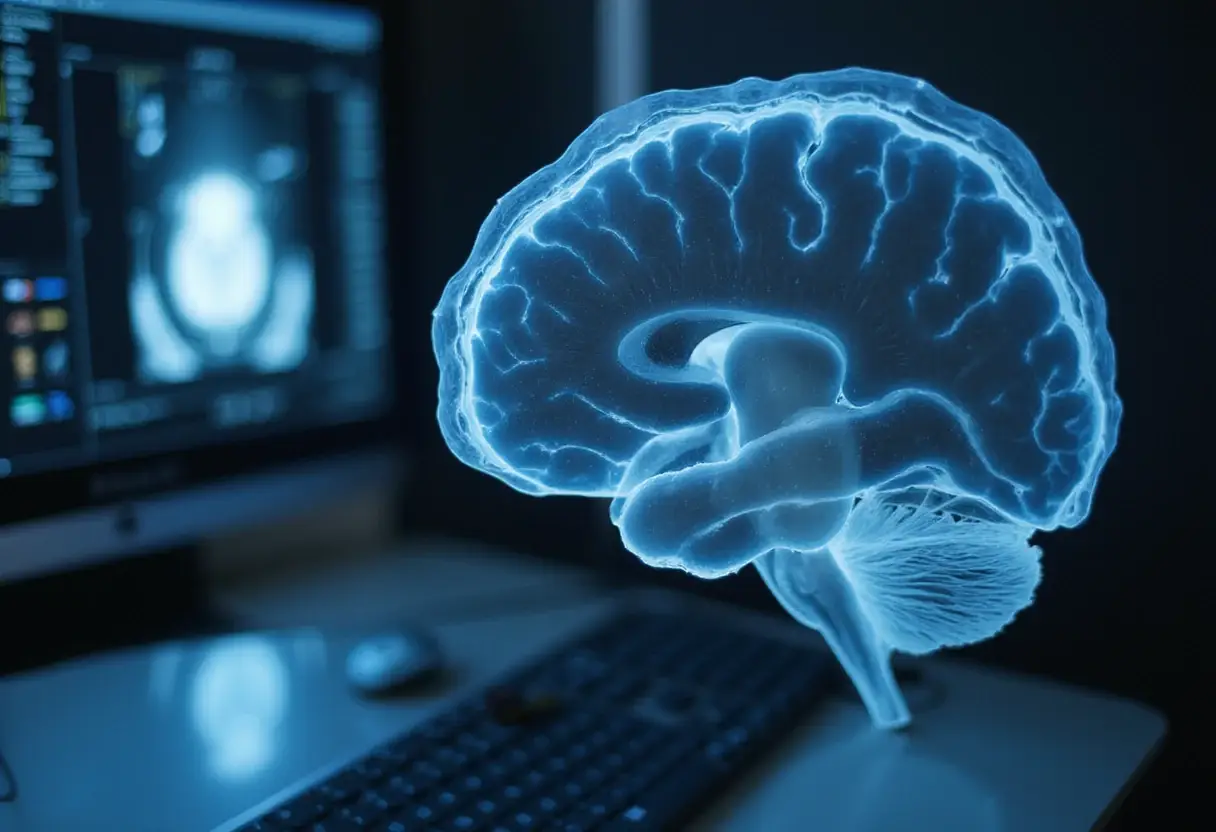
A paper titled "Ultrasound Brain–Computer Interfaces for Transcranial Closed-Loop Neuromodulation" is now available through Science Partner Journals, according to a publisher release.
The work pairs focused ultrasound and BCI feedback to drive transcranial, closed-loop neuromodulation — a configuration distinct from the scalp EEG, intracranial EEG, ECoG, MEG, and EMG/EP workflows that fill today's monitoring units, epilepsy surgery conferences, and intraoperative reading rooms.
What does the configuration change for practitioners?
Transcranial delivery is non-invasive. The ultrasound beam passes through the intact skull and focuses at cortical or subcortical depth, removing the craniotomy that intracranial recording and conventional deep-brain stimulation require.
The BCI layer reads neural state continuously and triggers ultrasound output only when a target signature emerges in the decoded signal. Closed-loop systems adjust output in response to measured brain state, ideally matching dose to moment-by-moment activity that scalp EEG or intracranial recordings would otherwise just display.
For the epilepsy monitoring unit, the practical interest is whether a non-invasive system can match the trial-by-trial adaptivity of responsive neurostimulation. RNS reads local field potential from up to two seizure-onset zones and triggers a charge in the same leads. An ultrasound-based analog would read non-invasively but stimulate focally — a different physical pathway toward the same clinical goal.
RNS has accumulated more than a decade of multicenter outcomes, with median seizure reduction in the 50-70% range at two years for adults with drug-resistant focal onset seizures. Any non-invasive alternative will face a high bar against those published numbers.
Why ultrasound instead of electrical or magnetic stimulation?
The three modalities trade focality, depth, and invasiveness differently:
- Focused ultrasound — sub-MHz to low-MHz mechanical pressure waves, focal spots on the order of a few millimeters at depth
- TMS — induced currents via magnetic fields, typical pulse trains in the 1-20 Hz range
- tDCS — low-amplitude direct current between scalp electrodes, diffuse focality
The FDA has cleared focused ultrasound systems for thalamotomy in essential tremor and Parkinson's. Those are ablative, not closed-loop. The release does not claim FDA status for the new work, and no human-cohort result, device specification, or stimulation parameter appears in the public material.
What does this study actually establish?
The release names the modality — transcranial, ultrasound-based, closed-loop, BCI-driven — but does not specify:
- Stimulation frequency or focal depth
- Animal versus human cohort
- Sample size
- FDA clearance status
The work is best read as an early methodological contribution at the intersection of BCI and focused ultrasound, not as a cleared clinical device.
What to look for in the full paper
Practitioners tracking this line should pull the full Science Partner Journals text to confirm:
- The recording method feeding the BCI (electrophysiology, acoustic, or hemodynamic)
- Animal model, healthy volunteer, or patient cohort
- Ultrasound parameters and safety data
- Performance benchmarks against scalp EEG or intracranial baselines
Without those numbers, the work remains conceptual for clinical translation.
Looking ahead
A paper that fuses focused ultrasound with BCI feedback points neuromodulation toward non-invasive, closed-loop operation. Clinical traction will hinge on replication, regulatory clarity, and published parameters practitioners can benchmark against the established scalp and intracranial stacks.
Based on
Marcus Bennett
Show full bio
Staff writer covering technology and product news in Clinical neurophysiology and EEG interpretation at EEG Signal.