128-Electrode EEG Study Rewrites Face Processing in Autistic Brains
A Yale-led 128-electrode EEG study of about 400 children finds face-related brain signals less distinct in autism, with differences arising before the N170 component.
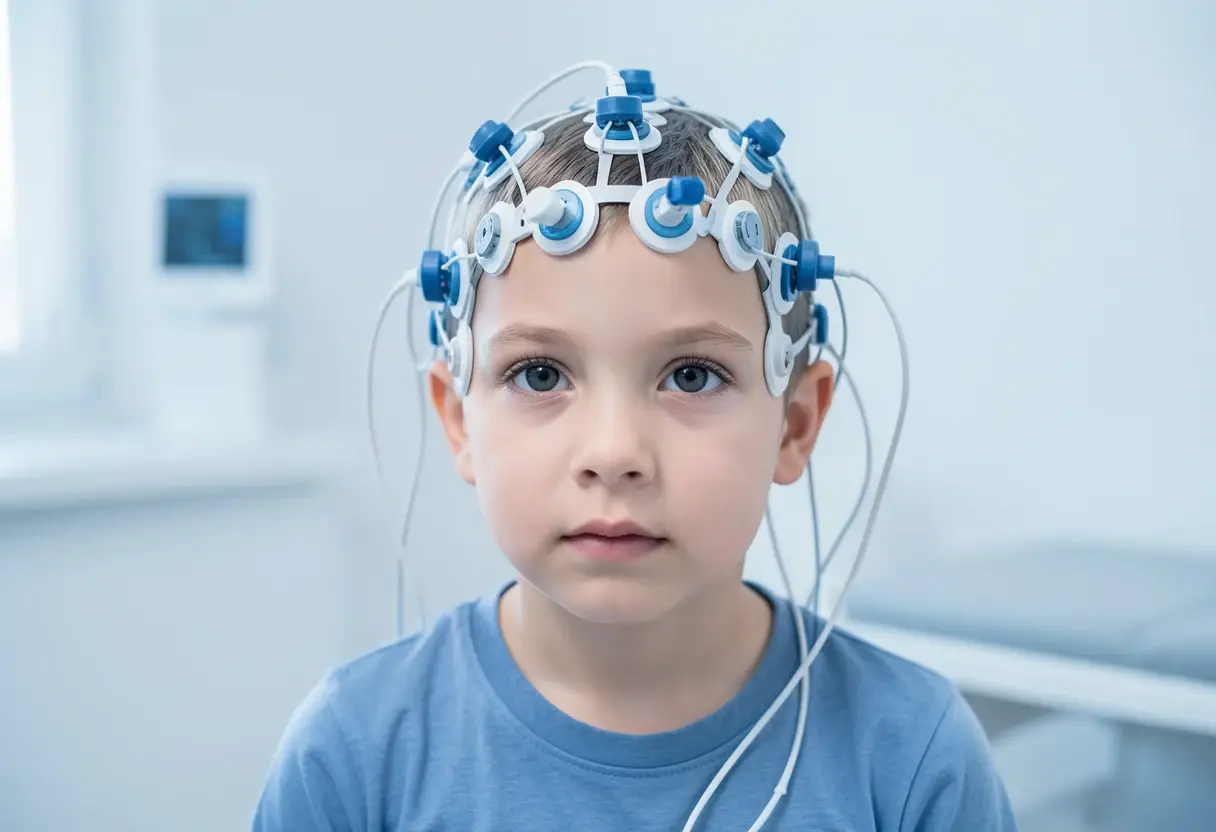
A scalp EEG study of approximately 400 autistic children, published in Nature Mental Health on October 27, 2026, has found that brain signals for face recognition are less distinguishable in autistic children than in neurotypical peers — and that the differences begin earlier in visual processing than the well-studied N170 component.
The research, led by James McPartland, PhD, Harris Professor in the Child Study Center and director of the Center for Brain Mind Health at Yale School of Medicine, is among the most extensive investigations yet into how face perception works in autism. Unlike earlier EEG studies, which examined signals from a handful of electrodes, the team analyzed the full 128-electrode montage recorded around each child's scalp.
How the study was run
The researchers drew on data collected through the Autism Biomarkers Consortium for Clinical Trials (ABC-CT), a dataset spanning autistic and neurotypical children across different age groups. During the experiments, participants viewed pictures of faces and everyday objects while EEG equipment recorded their brain activity. The scientists then applied machine learning techniques to determine whether patterns in the recordings could reveal what each child was viewing.
McPartland compares traditional approaches to studying face recognition with an impossible task: understanding traffic across an entire city by monitoring a single downtown street.
"That's the way most research on face processing so far has worked," McPartland says.
What did the full-scalp recordings show?
Two findings emerged. First, brain activity provided a clearer indication of face viewing in neurotypical children than in autistic children.
"The neural activity that we measure at the scalp is just not as distinct in autistic children," says first author Jason Griffin, PhD, assistant professor of psychology at the University of Houston and a former postdoctoral researcher in McPartland's laboratory.
Second, the ability to identify what a child was viewing from brain activity improved with age among neurotypical participants. Autistic children showed no such age-related improvement, suggesting their neural responses to faces develop along a different trajectory.
"Their face-specific processing is not following the same trajectory," Griffin says.
The finding extends earlier Yale work from the early 2000s, which reported that brain regions responsible for processing faces showed lower activity in autistic individuals than in people without autism.
Why the timing matters
Recognizing a face involves multiple stages of neural processing, beginning when visual information enters the eyes and ending when the brain interprets that information as a familiar face. Much of the earlier research in autism concentrated on the N170, a measurable change in electrical activity that typically occurs about 170 milliseconds after a person sees a face and that previous studies found to be delayed in autistic individuals.
By analyzing brain activity over a wider temporal window, the researchers found evidence that autism-related differences begin before this familiar signal appears — pointing to earlier stages of visual processing than researchers had previously established.
"When you look at face processing through an approach that's more inclusive of the full temporal range of information, we're seeing that differences in autism occur even earlier," McPartland says.
What could this change clinically?
Clinicians currently diagnose autism primarily through behavioral evaluation, because no reliable biological test exists for routine use. The newly identified patterns of face-related brain activity could contribute to ongoing biomarker research, potentially helping to distinguish groups within the autism spectrum or to identify children likely to benefit from particular supports, including social skills therapy.
"This is a first step in introducing a new biomarker," McPartland says.
The developmental findings also carry practical weight. Historically, some clinicians attempted to address face perception difficulties by requiring autistic individuals to maintain eye contact, an approach research has since shown to be ineffective. Because the observed differences appear during development, the study raises the possibility that support aimed at helping autistic children interpret facial emotions could be especially beneficial when introduced earlier in childhood. The researchers note that the patterns suggest the differences reflect underlying developmental characteristics of autism rather than accumulated life experience.
The team emphasizes that autism does not necessarily create difficulties requiring intervention: many neurodivergent people experience little or no related impairment and may neither need nor want additional support.
"Imagine navigating life when it's hard for you to perceive the information in another person's face, from navigating a playground to navigating a job interview," McPartland says. "This is one of the critical areas that causes difficulty for many autistic people."
More research is necessary before the findings reach clinical practice, but the full-scalp, full-temporal decoding approach gives reading rooms and research labs a new framework for tracking how face-specific responses change across childhood in autism.
By Priya Raman
Based on
Source: Google News: EEG.
Priya Raman
Show full bio
Market editor covering regulation, policy and their impact on Clinical neurophysiology and EEG interpretation at EEG Signal.