Consumer Earbuds with EEG Positioned for Overnight Sleep Use
Sleep Review reports a consumer earbud that pairs EEG acquisition with audio playback for sleep improvement. The source provides no device name, validation study, or FDA status, leaving the clinical question open.
Updated
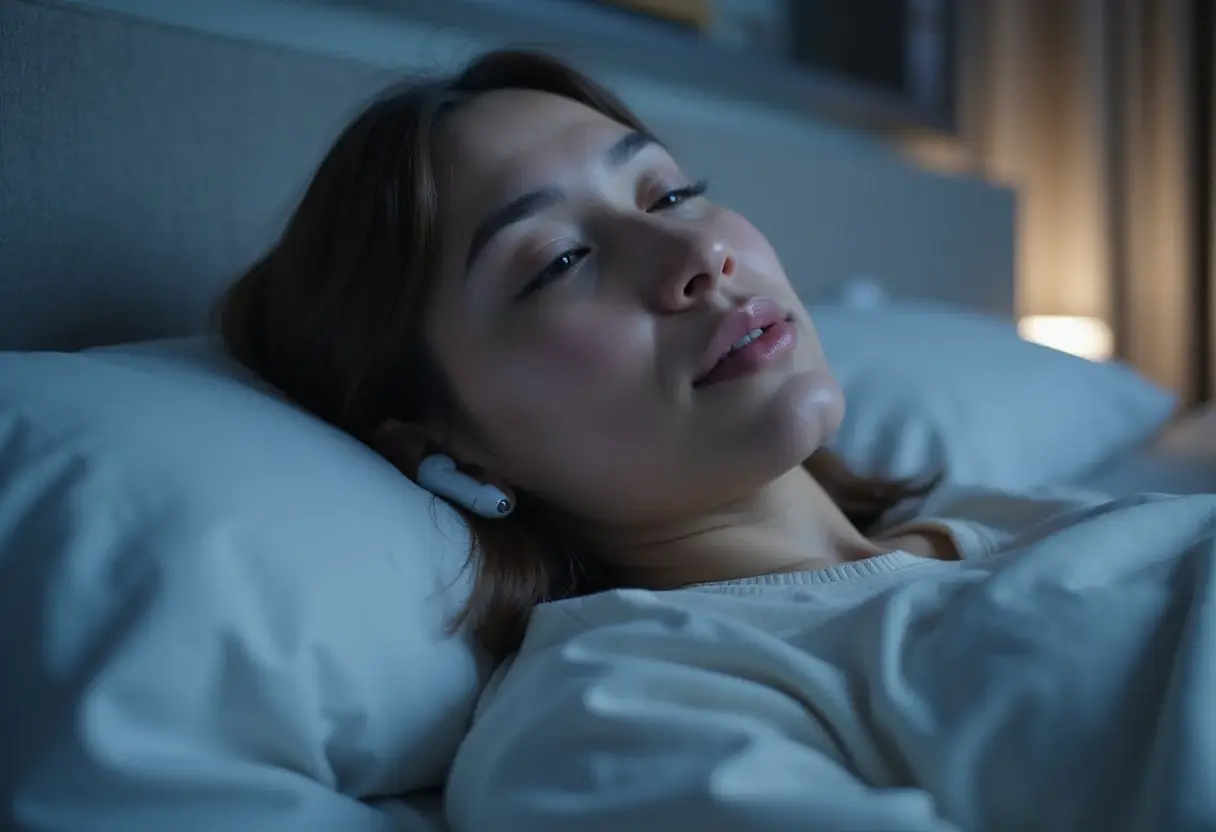
A consumer earbud fitted with EEG electrodes targets sleep improvement, according to a headline in Sleep Review. The product folds audio playback and brain recording into a single in-ear unit — the latest attempt to compress clinical-style acquisition into a wearable built for home use.
What the headline states
Sleep Review's headline — "Smart Earbuds Use EEG Technology to Improve Sleep" — names the form factor and the claim. The available source provides no further detail: no device name, no vendor, no study cohort, no validation reference, no regulatory status. Practitioners should treat the announcement as a signal. Not as evidence.
Why the recording site matters
Scalp EEG with a 10-20 montage remains the reference standard for sleep scoring under AASM criteria. Moving the electrodes into the ear canal changes signal geometry, attenuating some spatial features and emphasizing others. In-ear channels typically capture slow-wave activity and propagation of eye-movement artifacts through bone and tissue, but the channel set departs from the standard 10-20 scheme.
The clinical question is narrow and answerable. Does the abbreviated channel set support reliable sleep staging at the epoch level, across a full night, in adults without sleep disorders?
For neurophysiologists, the key unknown is signal quality relative to a frontal or central scalp derivation. Frontal EEG carries the slow oscillations, K-complexes, and spindles that anchor N2 and N3 scoring. An in-ear derivation that preserves those waveforms supports a clinical workflow. One that replaces them with a derived index does not.
What practitioners should request
A consumer EEG sleep device intended for clinical use should publish, before any referral:
- Electrode count, reference, and ground configuration
- Epoch-by-epoch agreement with attended polysomnography, expressed as Cohen's kappa against AASM scoring
- Performance reported separately for N1, N2, N3, and REM
- Total sleep time, sleep efficiency, and wake-after-sleep-onset bias against PSG
- FDA 510(k) status or equivalent regulatory clearance
- Failure-mode data — what the device reports when electrodes lose contact mid-night
A wellness device without those numbers can be sold to consumers. It should not enter a clinician's referral pathway.
The regulatory split
A device that diagnoses sleep disorders falls under FDA medical-device review. A device that tracks sleep for general wellness does not. The two paths produce very different evidence bases. The Sleep Review headline does not state which category this product occupies. That distinction will decide whether clinicians can rely on the output.
What changes for the reading room
If validated against PSG, in-ear EEG would let sleep laboratories extend monitoring into the home without a full head-mounted montage. Setup time falls. Patient compliance over multi-night studies rises. The form factor favors longitudinal data — the night-to-night variability that a single PSG night cannot capture. The interpretive workload shifts from the technologist in the lab to whoever reviews the uploaded files the next morning.
What to watch
Sleep Review's full article, accessible through the source link, will likely carry the device specifications, the validation study, and any regulatory filing. Until those numbers surface, the only fact in hand is the headline. EEG has moved into the ear canal. Sleep-medicine programs should expect patient inquiries before the next referral cycle.
Based on
Source: Google News: Wearable EEG.
Marcus Bennett
Show full bio
Staff writer covering technology and product news in Clinical neurophysiology and EEG interpretation at EEG Signal.