Intraoperative & Critical Care
Intraoperative Neuromonitoring During Woodward Procedure: 5-Year Data
A retrospective series with mean five-year follow-up reports outcomes of the Woodward procedure for Sprengel deformity performed under continuous intraoperative neuromonitoring.
Updated
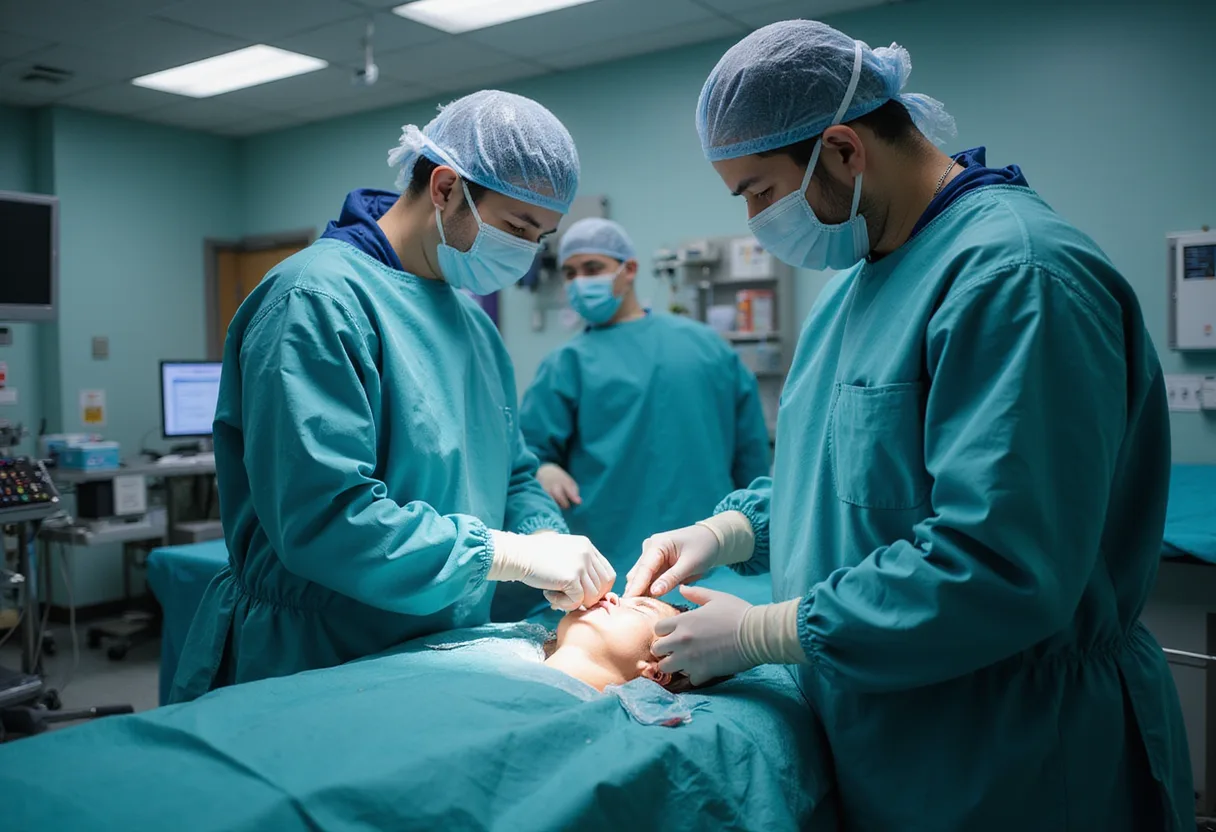
A retrospective study with a mean follow-up of five years examines how surgeons performed the Woodward procedure for Sprengel deformity while running intraoperative neuromonitoring throughout the operation. The paper, published in Frontiers, pairs one of the standard operative corrections for this rare congenital shoulder anomaly with continuous neurophysiologic surveillance — a combination the authors followed well beyond the immediate perioperative window.
Sprengel deformity is a congenital elevation and malrotation of the scapula, and the Woodward procedure remains a reference surgical option for functionally significant cases. The operation detaches and repositions the trapezius and rhomboid origins to descend the scapula on the thorax. The anatomy matters for the monitoring team: the approach works in the territory of the spinal accessory nerve, which innervates the trapezius, and of the dorsal scapular nerve serving the rhomboids. Brachial plexus structures and the suprascapular nerve also sit within the operative field's influence, particularly when corrective maneuvers alter shoulder position and traction across the thoracic outlet.
The study's design is retrospective. The authors reviewed their institutional experience with patients who underwent the Woodward procedure under intraoperative neuromonitoring, and they report outcomes extending to a mean of five years after surgery. That follow-up horizon deserves attention on its own. Much of the published experience with Sprengel deformity correction concentrates on radiographic correction, cosmetic grading, and short-term complications. A series that tracks the same cohort out to five years gives reading-room and monitoring-unit colleagues a longer arc against which to weigh both the durability of the bony and muscular correction and the neurologic integrity of the shoulder girdle's motor apparatus.
For neurophysiologists, the relevance is straightforward. Intraoperative neuromonitoring in this setting classically combines free-running and triggered electromyography from muscles innervated by the nerves at risk — trapezius for the spinal accessory nerve, rhomboid for the dorsal scapular nerve, and depending on institutional protocol, deltoid, biceps, and other brachial plexus-innervated targets. Surgeons use spontaneous EMG activity such as neurotonic discharges as a real-time warning of mechanical or thermal irritation of a monitored nerve, and triggered EMG to probe nerve proximity during dissection. The monitoring protocol also serves a second function in deformity surgery: verifying that the corrected scapular position does not place the brachial plexus under injurious traction once the shoulder girdle is repositioned.
The five-year follow-up gives the study its practical weight. Intraoperative neuromonitoring earns its place in the operating room only if signal changes correlate with postoperative function, and if the absence of alarming changes predicts an intact motor exam years later. A retrospective series cannot prove causality, and readers should hold the findings to that standard. What a well-documented retrospective cohort can do is describe the observed relationship between monitoring events, immediate neurologic outcomes, and long-term shoulder function across a consecutive surgical experience — and flag whether any patient sustained a nerve deficit that monitoring either predicted or failed to predict.
Sprengel deformity itself sets the clinical stakes. The condition is uncommon, and surgical series are correspondingly small, which makes every systematically followed cohort valuable. Indications for surgery generally rest on functional limitation and the degree of scapular elevation, with the Woodward procedure favored when the deformity permits muscular repositioning. Because the operation is elective and performed most often in children and adolescents, the tolerance for neurologic complication is low, and the argument for continuous neuromonitoring rests on making a low-risk operation safer still.
The monitoring-unit takeaway from this line of work concerns preparation. Teams asked to cover Woodward procedures should confirm which motor targets the surgeon wants instrumented before the case, position the patient for access to the parascapular and upper-limb musculature, and agree in advance on alert criteria for both free-running EMG activity and any change that follows scapular descent or traction maneuvers. Documentation should record the timing of any signal change relative to specific surgical steps, because that timestamp is what makes a retrospective analysis like this one interpretable years later.
The study is a clinical, human, retrospective investigation — not a trial of a device and not animal work — and the monitoring it describes uses established, commercially available neurophysiologic equipment rather than any investigational technology. Its contribution is the pairing of a specific orthopedic procedure with longitudinal neurophysiologically informed outcome data, an area where the literature remains thin.
Whether intraoperative neuromonitoring becomes standard practice for the Woodward procedure will depend on accumulating series like this one, and the five-year follow-up reported here offers a longer baseline against which future prospective studies of monitoring-guided Sprengel deformity surgery can be designed.
Based on
Priya Raman
Show full bio
Market editor covering regulation, policy and their impact on Clinical neurophysiology and EEG interpretation at EEG Signal.