Neurable One Puts 12-Channel EEG Into $500 Wireless Headphones
Neurable launched the $500 Neurable One wireless headphones with 12 EEG sensors in the ear pads, streaming continuous brain tracking to a mobile app for focus and cognitive load estimates.
Updated
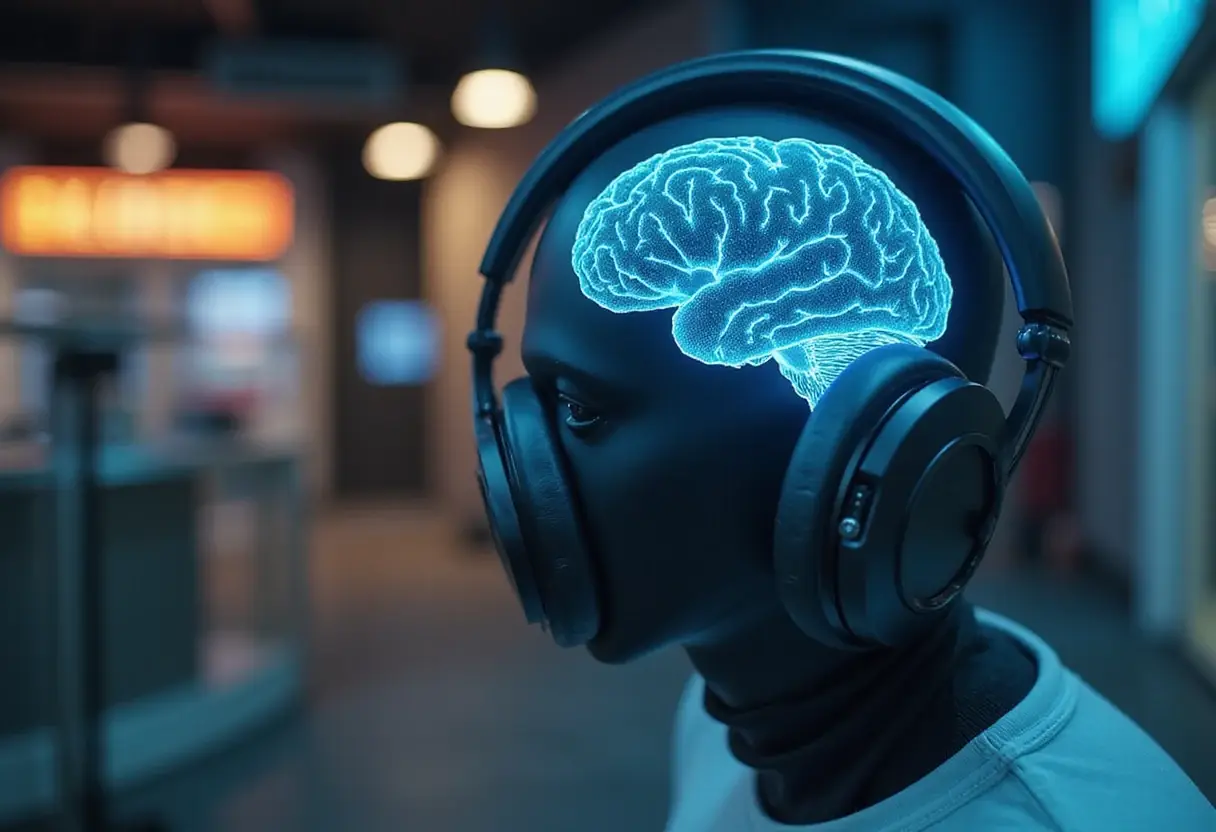
Neurable has launched Neurable One, a $500 pair of wireless over-ear headphones built around 12 EEG sensors integrated into the ear pads, with US retail availability announced this month.
The device combines premium audio and active noise cancellation with continuous scalp EEG recording through dry electrodes housed in the cushion. Signals stream over Bluetooth to a companion iOS and Android application, where the company's cloud pipeline renders cognitive-state estimates in real time.
Neurable markets four primary outputs: focus, cognitive load, cognitive speed, and a composite metric the company calls "brain battery." A second readout, Alpha Peak Frequency, tracks the dominant resting rhythm across sessions.
What can the headset actually measure?
The system does not report raw EEG traces to the user. Closed algorithms translate power-spectrum features into categorical states and trend lines. The 12-channel configuration is denser than typical consumer single- or two-channel headbands, but electrode placement is fixed at the ear-pad interface. That placement samples temporal and periauricular regions, with limited coverage of frontal, central, and posterior scalp sites used in standard clinical neurophysiology.
Neurable positions the product as a wellness and productivity tool, not a diagnostic instrument. The company has not announced FDA clearance or a pending submission for the hardware or its derived metrics.
How does it fit alongside clinical practice?
For clinical readers, the device sits in the same consumer-neurotechnology category as earlier single-channel EEG headbands. It is useful for longitudinal self-tracking of subjective cognitive state. Signal quality and topographical coverage remain well below the international 10-20 montage used in epilepsy monitoring or routine EEG reporting.
The closed-source algorithm also means clinicians cannot independently verify how spectral features map to the labeled outputs. Independent peer-reviewed validation of the focus and cognitive-load classifiers against task-based gold standards has not been published.
What does the company say?
"Neurable One is the product we've been working toward for more than a decade," CEO Ramses Alcaide said in a statement. "Our vision has always been a future where understanding your brain is as seamless as tracking your steps or checking your heart rate."
The launch extends Neurable's existing work with OEM partners that embed the company's brain-signal processing platform into gaming headsets, hearing protection, and helmets.
What does the app add beyond live metrics?
The app offers neuroadaptive audio that adjusts output to detected cognitive state, "Smart Brain Breaks" triggered by signs of mental fatigue, and weekly or monthly trend reports. A "Brain Data Banking" feature stores session-level EEG whenever the app is open and the headphones are worn, building a longitudinal record on the user's account.
What does this mean for monitoring units and labs?
For epilepsy monitoring units and clinical neurophysiology labs, the device is unlikely to replace standard acquisition systems. Its clinical relevance is indirect: it may prompt patient questions about consumer EEG data and offers a low-cost demonstration of continuous scalp recording outside the lab.
Any longitudinal claims about cognitive decline, attention disorders, or fatigue should still be evaluated with medical-grade EEG and validated neuropsychological testing. Pricing of $500 places Neurable One above mainstream consumer headphones but well below entry-level research-grade EEG systems.
If independent groups publish validation of the focus and cognitive-load classifiers against established neuropsychological batteries, Neurable One could become a useful adjunct for self-monitoring in clinical populations. Until then, the device remains a consumer wellness product whose outputs should be read as suggestive rather than diagnostic.
Based on
Original: go.gamesbeat.com.
Marcus Bennett
Show full bio
Staff writer covering technology and product news in Clinical neurophysiology and EEG interpretation at EEG Signal.