Subcutaneous EMG Implant Controls Prosthetic Arms in Two Patients
Phantom Neuro implanted a 2-by-10 cm subcutaneous EMG device in two Melbourne patients; the second procedure took 45 minutes without general anesthesia, feeding muscle signals to prosthetic arms.
Updated
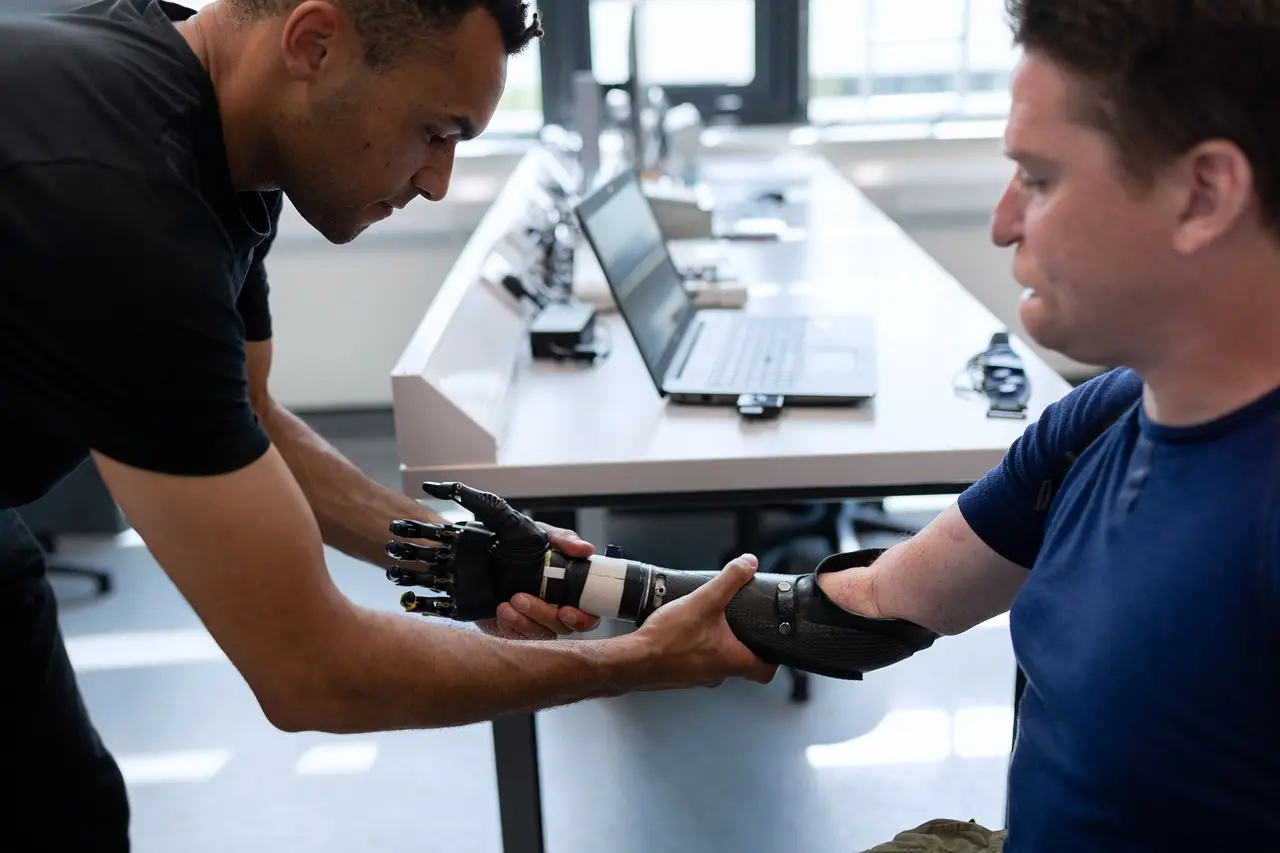
Two patients in Melbourne have become the first people to receive a subcutaneous electromyography implant for prosthetic arm control, and the second procedure took 45 minutes, without general anesthesia, with discharge inside three hours. Phantom Neuro, the Austin, Texas company behind the device, announced the milestones on 20 October, roughly five months after the first implantation.
The device is a 2-by-10-centimetre band that wraps around the forearm beneath the skin, where its two rows of electrodes — embedded in flexible medical silicone — record muscle electrical activity. A disk of electronics processes the signal and transmits it wirelessly to third-party prostheses; a central coil delivers power from an external source, on the same principle as a cochlear implant. Machine learning maps muscle signals to specific gestures, at variable speeds.
This is not a brain interface. It is implanted EMG, and the company frames the surgery accordingly.
What does the implantation look like in practice?
The first recipient, Michael Easy, a 32-year-old carpenter from Hastings, Victoria, spent about an hour under mild sedation, with the full process taking four hours. He reported soreness for two days and swelling for two weeks. "It was a bit sore and tender for the first couple of days and then it healed so quick, there was no drama whatsoever," he said in statements relayed by Phantom Neuro.
The second participant fared better on time. No general anesthesia, 45 minutes, out of the hospital in three hours. For comparison, neural implant procedures can run many hours.
"The goal with this tech is to give amazing control, but with outpatient [care] more like a cosmetic procedure than brain surgery," said founder and CEO Connor Glass. He describes the surgery as creating a pocket under the skin, comparable to common cosmetic implant procedures, with removal expected to be simpler than implantation.
How strong is the evidence?
The procedures mark the first results from an early feasibility trial in humans, approved by Australian regulators in April and registered as NCT07325708. Its stated aim is safety. That distinction matters: this is investigational work, two patients, early days.
Early performance has promising elements. Muscle signals have been strong and consistent, according to Glass, and calibration between intent and gesture may hold for months, rather than the daily recalibration some surface EMG systems require. "This implant has made everything easier and smoother and faster," said Easy.
Outside experts were measured. "I see a tremendous potential benefit for patients to use every day more reliably," said Helen Huang, a biomedical engineer at North Carolina State University, while noting the field needs more public technical information. "Ultimately, these potential advantages must translate into tangible benefits for users, including more natural and reliable prosthetic control, reduced effort, and improved performance in daily activities," said Loredana Zollo of the Università Campus Bio-Medico di Roma.
Why go under the skin at all?
Surface EMG electrodes are cheap and common, but finicky. Slight misplacement degrades the signal, sweat shifts impedance, motion creates artifacts, and activity worsens all of it. The subcutaneous route avoids those problems while introducing its own: the implant must survive minor daily impacts and keep its power coupling stable as the arm and skin move.
There are functional limits too. The current system cannot yet combine motions — wrist rotation and finger movement together, for instance — and handles some tasks step by step. Glass's long-term target is "simultaneous proportional control" through more sophisticated pattern recognition. The company also had to engineer compatibility across commercially available prostheses, which lack standardized communication protocols.
What does this change for the reading room and the lab?
For now, nothing on the bench: no commercial system using implanted EMG exists for either upper or lower limb prostheses. What changes is the risk calculus for signal acquisition. The trial tests whether a minimally invasive, outpatient-grade implant can deliver the signal quality that brain-machine interfaces chase at far greater surgical cost.
Glass expects clinical trial progression to reach FDA approval for upper limb prosthesis control in two to three years. Lower limb prostheses and defense-oriented human-machine applications follow on the roadmap. Two patients have healed quickly. Many more will decide whether the signals hold.
Based on
Original: phantomneuro.com.
Elena Vasquez
Show full bio
News editor covering people, launches and day-to-day practice in Clinical neurophysiology and EEG interpretation at EEG Signal.